
Turning a Miner's Spec Sheet Into a Calendar
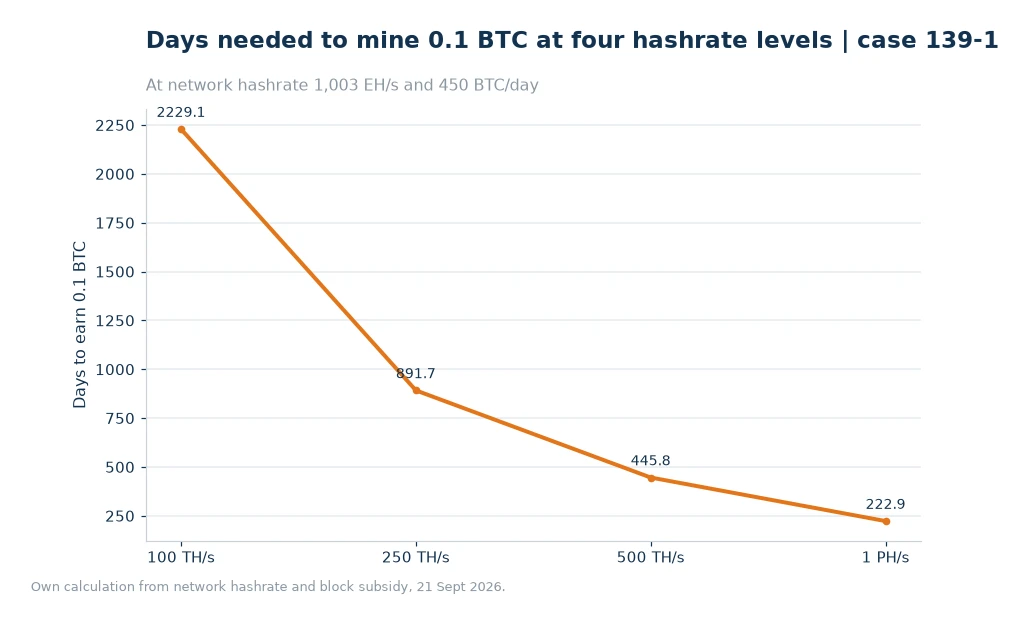
A purchase decision usually gets made on watts, terahashes and a price tag. The number that decides whether the machine does what you want is none of those: it is how long the thing takes to produce the amount of BTC you actually care about. At 100 TH/s and current network conditions, 0.1 BTC takes about 2,229 days. At 1 PH/s the same target takes 223 days. Same coin, same network, a tenfold difference in patience required.

Key takeaways
- 0.1 BTC takes 2,229 days at 100 TH/s, 892 days at 250 TH/s, 446 days at 500 TH/s and 223 days at 1 PH/s.
- Doubling hashrate halves the calendar only if the network total stays put, which it rarely does.
- Pool Hashrate tells you the size of the group you are joining; Pool Luck tells you how block discovery has run, which a PPS+ credit ignores.
- Convert every purchase into a date range before comparing it with the invoice.
Two figures on the box, one that is not
Manufacturers publish hashrate and power, because those are the things they control and the things buyers compare. The calendar is a function of those two figures plus three inputs the manufacturer does not control: the block subsidy, the total network hashrate and, indirectly, the price you assign to the coin. That is why two machines with identical nameplate numbers can look like completely different purchases once the target amount is written down.
The useful habit is to convert before you compare. Take the target you actually want to reach, whether that is 0.01 BTC, 0.1 BTC or a figure that covers a specific bill, and divide it by the daily credit at the machine's hashrate. The result is a date, and dates are much harder to argue with than specifications.
Why the target changes the answer more than the machine
Choose a target of 0.1 BTC and the machine size dominates: the spread between 100 TH/s and 1 PH/s is a factor of ten, and no amount of clever operation closes that. Choose a target of 0.001 BTC and the same four machines all finish inside a fortnight, so the purchase decision shifts almost entirely to cost per terahash and to power. The target is the variable most buyers leave implicit, and it is the one that decides which specification actually matters.
Write the target down with a reason attached. "0.1 BTC because that is the balance I want before I consider selling" is a workable reason. "As much as possible" is not a target; it is a preference, and it will push you toward the largest machine you can finance rather than the one that fits the plan.
Where the network numbers live
Every calendar estimate rests on a snapshot. On 21 Sept 2026 the snapshot read 1,003 EH/s of network hashrate, difficulty at 132.76 T and a subsidy of 3.125 BTC per block across 144 blocks a day, which is 450 BTC issued daily. Those are the inputs behind the figures in this article, and they move. The ViaBTC BTC Mining Pool state view is one place to watch them, alongside the pool's own share of the network.
Two labels on that page deserve a plain explanation. Pool Hashrate is the combined speed of all machines pointed at the pool, and it decides your slice of each settlement: if the pool's hashrate rises while yours stays flat, your percentage falls even though nothing about your rig changed. Pool Luck compares blocks found with blocks expected over a period, and it is a diagnostic of discovery rather than a promise about your income, particularly under PPS+ where the hourly credit does not depend on it.
The recalculation nobody does after month one
Calendars built at purchase time assume a static network. The network is not static. A difficulty adjustment of a couple of percent every two weeks compounds into a meaningful shift over a year, and the estimate printed on the day of purchase is usually optimistic by the time the machine is installed and running. Treat the number as a starting point with a range attached, not as a schedule.
The practical fix is to recompute on a fixed date each month using the same formula, and to note the change rather than reacting to it. Two consecutive months of lengthening calendars is information: it tells you the network is growing faster than your fleet, which is the normal condition of mining and the reason efficiency, not size, tends to decide who stays. None of that requires a spreadsheet beyond four columns.
| Hashrate | BTC per day | Days to 0.1 BTC | Roughly |
|---|---|---|---|
| 100 TH/s | 0.00004486 | 2,229.1 | 6 years 1 month |
| 250 TH/s | 0.00011215 | 891.7 | 2 years 5 months |
| 500 TH/s | 0.00022430 | 445.8 | 1 year 3 months |
| 1 PH/s | 0.00044861 | 222.9 | 7 months 10 days |
Read the last column against the warranty on the machine you are considering. If the calendar is longer than the period the hardware is likely to stay competitive, the purchase is really a bet on a price you have not named. That is a legitimate thing to do, but it should be a decision rather than a surprise.
Worked example
Take the 250 TH/s row and rebuild it from the chain data.
- Daily BTC per TH/s: 450 ÷ 1,003,000,000 = 0.00000044865.
- At 250 TH/s: 250 × 0.00000044865 = 0.00011216 BTC a day, which rounds to 0.00011215.
- Days for 0.1 BTC: 0.1 ÷ 0.00011215 = 891.7 days.
- In months: 891.7 ÷ 30.4 = 29.3, or about two years and five months.
- Value of the target at the read date: 0.1 × 84,692 = $8,469.20.
- Double the hashrate to 500 TH/s and the calendar halves to 445.8 days; the dollar value of the target does not change at all.
That last line is the whole argument in miniature. Spending twice as much on hashrate buys time, not a larger target, and time is only worth buying at a price you have already decided is fair.
Frequently asked questions
Does a bigger machine always shorten the calendar?
Yes for a fixed target and a fixed network, in direct proportion. Ten times the hashrate is one tenth the days, which is why 1 PH/s reaches 0.1 BTC in 222.9 days while 100 TH/s needs 2,229.1.
What does Pool Hashrate change for me?
It sets your share of each settlement. If the pool grows and your hashrate does not, your percentage of the pool falls, so the same rig credits less over the same period.
Should a purchase plan use today's difficulty or a forecast?
Use today's figure and add a range. Difficulty at 132.76 T on 21 Sept 2026 produced these numbers; the next estimate pointed to a small decline, and forecasts beyond one adjustment are guesses.
Price the date, then buy the machine
Before the order goes in, write three lines: the target in BTC, the calendar at the machine's hashrate, and the all-in cost including power over that period. If the third line is a number you would not lend at that horizon, the machine is not the problem and a larger one will not fix it. The Miner Profitability Ranking is useful for the cost side because it compares models against current conditions, and the Profit Calculator gives the daily figure you need for the second line.
Keep the calendar somewhere you will see it again in a month. Mining rewards patience in a way that spec sheets never show, and the operators who last are usually the ones who knew roughly when they would arrive before they started driving.
Sources: ViaBTC pool state, miner ranking and calculator pages, plus the fee page for the listed 4% on the PPS-settled block reward[1]. From the 21 Sept 2026 reading: 450 BTC issued per day, 132.76 T difficulty, 1,003 EH/s network hashrate, BTC $84,692. Figures read 21 Sept 2026, published 24 Oct 2026, with hashrate and difficulty held flat.