
Private Label Home Fragrance: Mistakes That Stall a Programme
Most private label home fragrance programmes do not fail dramatically; they stall. A sample is approved without a retained reference, the brief moves after sampling, a prototype component is treated as a production part, and the label is written in the last fortnight. None of these mistakes is expensive on its own. Together they turn a predictable programme into a series of restarts, and the cost shows up as missed retail windows rather than as a line item on a quote.
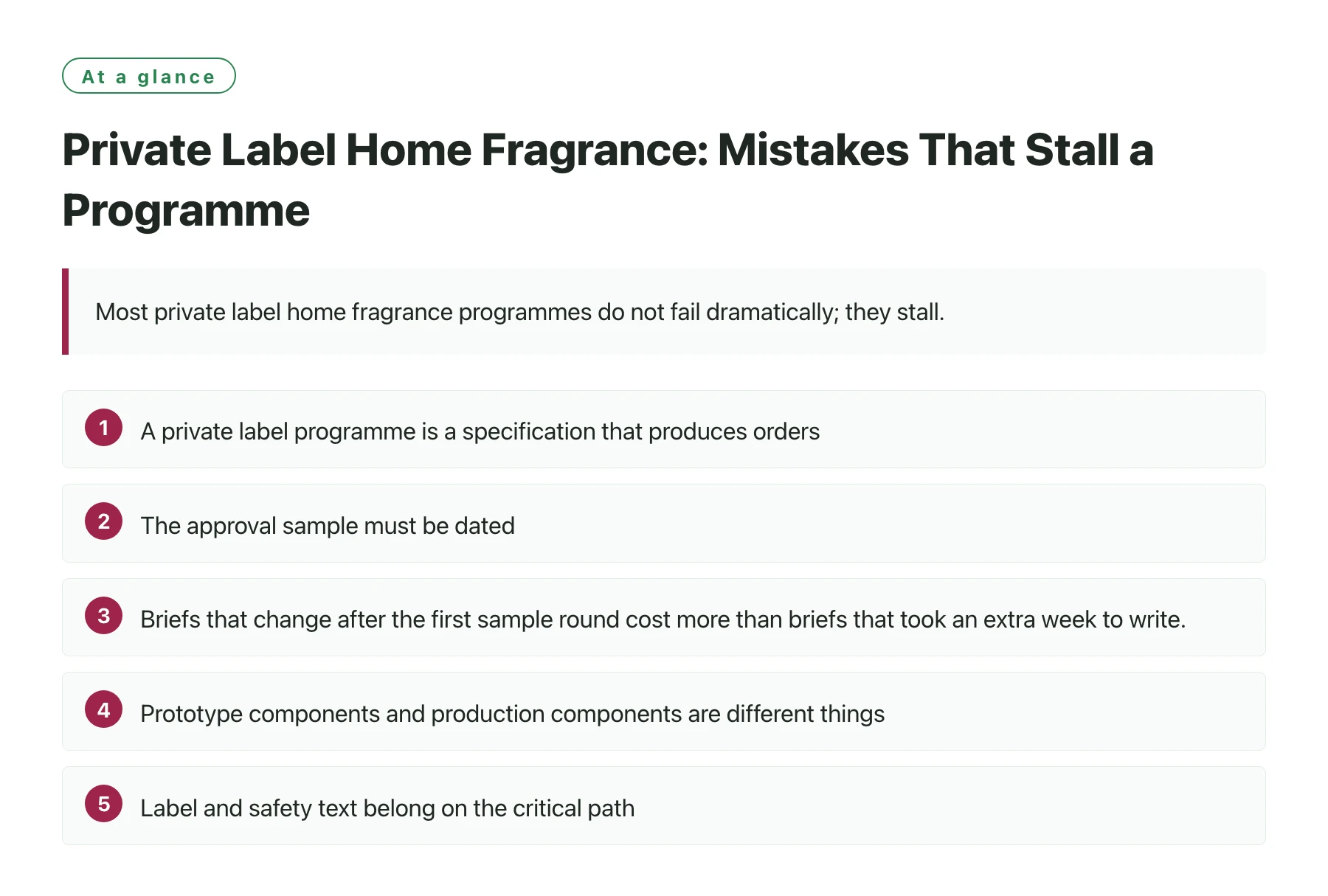
Key takeaways
- A private label programme is a specification that produces orders, not a purchase order that happens to include development.
- The approval sample must be dated, sealed and stored, with a twin at the factory, or production has nothing objective to match.
- Briefs that change after the first sample round cost more than briefs that took an extra week to write.
- Prototype components and production components are different things; wicks, collars, caps and inserts must be approved as production parts.
- Label and safety text belong on the critical path, because translation and print approvals take longer than teams expect.
- Every programme needs one named owner for approvals and one for market documentation, on the brand side.
Some delays are the supplier's, and a good buyer will spot those. The delays described here are the ones brands create for themselves, usually by treating a development programme as a straightforward order.
Each mistake below comes with the practical fix, so the pattern is easy to check against a programme already in progress.
Six mistakes, and how each one stalls a programme
The order of the mistakes matters less than the pattern: each one removes a piece of shared truth between the brand and the factory, and without shared truth every later decision has to be re-litigated.
Treating an order as a purchase rather than a specification
A private label programme starts with a specification: formats, fill weights, materials, components, tolerances, labelling, testing and packing. When those are never written down, the factory fills the gap with its own defaults and the brand discovers them at the first delivery. The fix is unglamorous — one controlled document, versioned and signed, before the sample round begins.
Approving a sample without a retained reference
The most common reason two deliveries differ is that nobody kept the thing they agreed on. Approval should produce a dated, sealed sample stored under agreed conditions, plus a twin at the factory. Both sides then compare production against the same object rather than against memory. This is particularly important for home fragrance, where scent is released from a wax or a base and can shift noticeably as the product settles.
Moving the brief after sampling
A brief that changes after the first sample round is a new project wearing the old quotation. The scent direction gets reworked, the label text changes, the packaging spec shifts, and the supplier has to hold two versions on the same order. The fix is to hold the brief still for a defined window and to log any change as a formal revision with its own cost and date.
Using an accord that was never built for the format
Accords adapt; they do not transfer. A composition developed on a blotter or in an alcohol spray will release differently from wax or a diffuser base, and performance has to be judged in the finished unit. Material restrictions also depend on how a product is used and dispersed, so the assessment must follow the format, not the family [1]. A supplier that proposes a direct transfer without retesting is signalling how it will handle the rest of the programme.
Approving prototype components
Samples are often assembled from hand-picked or prototype parts: a wick cut by hand, a collar from a different lot, a cap pulled from a bin. Production parts have tolerances, and tolerance is where physical complaints originate. Where a factory runs white label fragrance manufacturing, the specification should still name the production wick, collar or closure, and the approval sample should be built from production parts.
Leaving the label and warnings until the end
Usage warnings, hazard communication, ingredient disclosure and storage text all have to be written, translated, proofed and printed. On a multi-SKU range the label set multiplies, and the print stage cannot start without approvals. The industry press covers regulatory change continuously precisely because labelling requirements move and product teams get caught by them [2]. Put the label on the critical path and approve the full text rather than only the artwork.
Assuming one MOQ applies to the whole range
Minimum order quantities attach to components and to runs, so a range of five scents in one vessel does not behave like five separate products. That is the good news, provided the brand plans the range around shared components. It becomes a stall when each scent was specified with a different vessel, wick or cap, and the minimums stack up. A supplier working as a contract manufacturer for perfume brands will usually show both numbers: the minimum per component and the minimum per run.
The mistake underneath the mistakes
All six failures share one cause: no single person on the brand side owns the programme. Approvals arrive from three directions, changes are agreed in conversation, and the supplier is left to reconcile them. A named programme owner with authority to approve scent, specification and artwork removes most of the friction, and it costs nothing.
The second half of the fix is to test claims rather than accept them. A supplier's own pages — https://www.xuelei.com is one example — describe what the business offers, and that description should be checked against the scope, exclusions and test evidence in the quotation. Claims that survive that comparison are the ones worth building a range on.
None of this requires a large team. It requires decisions to be written, dated and owned, which is a discipline rather than a budget.
If a programme has been running for weeks without a signed specification or a sealed reference, stop and produce both. Continuing without them does not save the time already spent; it puts the next stage at risk too.
Sources
- IFRA Standards Library (International Fragrance Association) —— The IFRA Standards Library lists the restrictions the fragrance industry applies to individual fragrance ingredients, based on safety assessments; it is the reference point for compliant fragrance formulation.
- HAPPI — Household & Personal Products Industry —— An industry magazine covering the household and personal care market, including fragrance, formulation and packaging.
Frequently asked questions
How do I know whether a delay is mine or the factory's?
Look at what the delay is waiting for. If it is waiting for an approval, a document or a decision from the brand, it is yours. If it is waiting for components, testing or a production slot that was promised, ask for the record showing where the work sits.
Is it worth paying for a second sample round?
Usually yes, if the first round tested a direction that was close. A second round in the final format is cheaper than discovering the problem after the first delivery.
Can I approve labels after production starts?
You can, but the product cannot be packed and shipped until the labels exist. That is why the label text belongs on the critical path with the same status as the fragrance approval.
What does a programme owner actually do?
Holds one version of the truth: the specification, the approvals and the change log. Consolidates feedback before it reaches the supplier, and answers questions within an agreed time so the supplier is not waiting.
How many scents should share the same vessel in a first range?
As many as the design allows, because shared components reduce minimums and simplify packing. Distinctive vessels are better introduced once the range has proven itself.
Stop guessing. Start measuring.
Every tune developed and validated on our in-house Dynapack — gains you can verify on the screen and feel on the road.